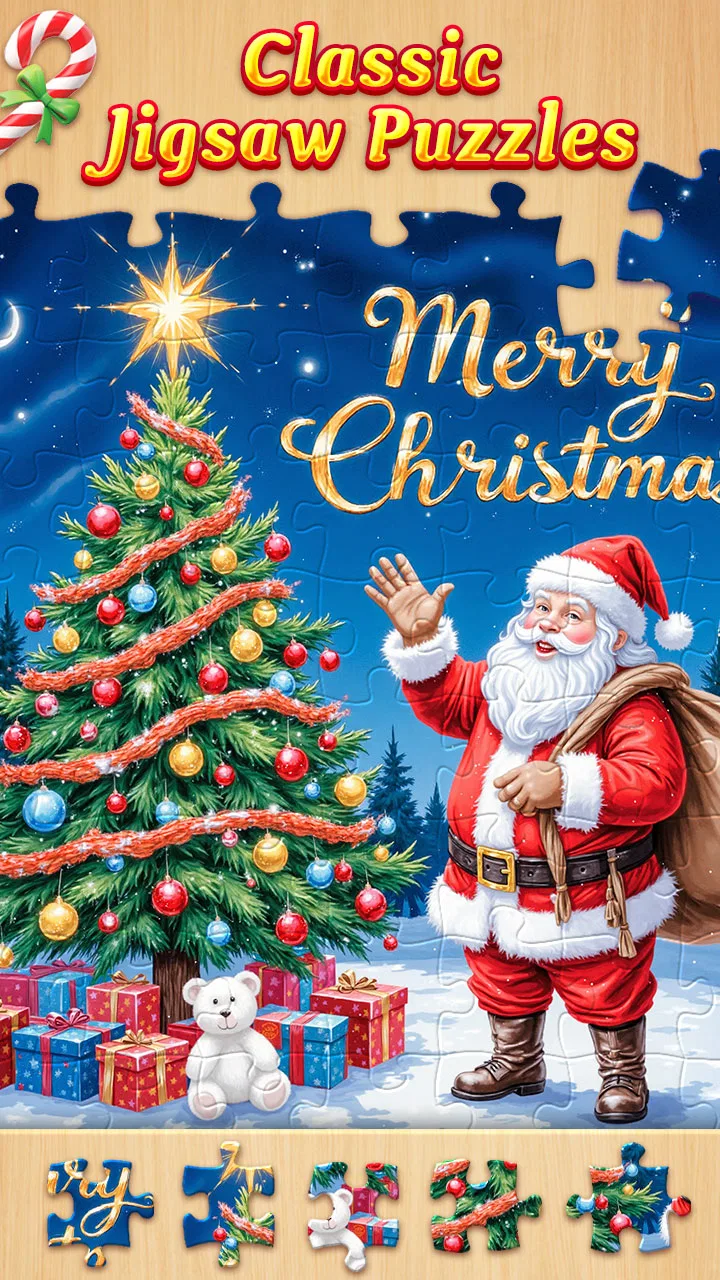
Classic Jigsaw
- 4.9
- Rating
- 500.00K
- Installs
- Free
- Price

 Analysis by App-foxy
Classic Jigsaw is the kind of trivia game I open when I want a quiet break rather than another noisy, demanding mobile experience. Its simple premise makes the first few minutes easy to understand: you work through a classic jigsaw puzzle at your own pace. That straightforward approach is also the reason it feels approachable for first-time players, casual puzzle fans, and anyone who prefers a calmer screen.
I reviewed it as a free game from Greyfun Games, listed for Everyone and available on Android devices running at least version 7.1. It has reached over one hundred thousand installs and holds a 4.8 average from roughly three thousand ratings, which suggests that its uncomplicated style is connecting with a sizeable audience. The current release is version 1.0.6, and the game was released on October 21, 2025.
What to expect when you begin
The most important thing to understand is that Classic Jigsaw is not trying to turn a familiar puzzle into a complicated competition. The appeal is the activity itself: looking for visual relationships, placing pieces carefully, and gradually watching a complete image appear. I found that restraint useful because it lets the puzzle remain the focus instead of burying it under instructions or distractions.
You May Also Like

 Blood Strike: 2.5 Anniversary
Blood Strike’s Loadouts Turn Every Drop Into a Tactical Gamble
A close look at Blood Strike’s custom loadouts: how fast access to signature weapons reshapes its battle royale rhythm, rewards preparation, and narrows the gap between fights.

 Pandora - Music & Podcasts
Pandora’s Music Is Easy to Start, but Harder to Recover
Pandora’s strength is its low-effort path from a seed to a station. Its weak spot is how much confidence it asks you to place in connection, setup, and quiet recovery.

 8 Ball Pool
 Is Built on Rivalries, Rematches, and Routine
A close look at the rivalries, rematches, shared routines, and unanswered safety questions that turn a quick pool match into a persistent mobile community.

 Samsung Music
’s Quiet Strength Is Playing What You Already Own
Its reach comes less from spectacle than from dependable access to a personal library. That simplicity is both the app’s strongest retention engine and its ceiling.

 AccuWeather: Weather Radar
AccuWeather Review: A Quick, Clear Forecast for Everyday Decisions
For everyday plans, the best forecast is the one you can understand quickly. AccuWeather makes rain timing, radar, and local conditions easy to act on, with a few trade-offs.

 Hill Climb Racing
Why Hill Climb Racing Still Turns Crashes Into One More Run
A tiny car, a bumpy hill and one more upgrade: Hill Climb Racing keeps resurfacing because its simple chaos makes every near-miss feel personal.
More From Our News Desk
View All News


The store description calls it “Classic Jigsaw,” and that is a good expectation to set. You should approach it as a traditional puzzle experience, not as a trivia quiz with questions and answers, despite its placement in the trivia category. If you are looking for rapid rounds, word clues, leaderboards, or a strong social component, this may not match what you have in mind. Its value comes from concentration and repetition rather than constant novelty.
That makes it particularly suitable for small gaps in the day. I can imagine using it while waiting for an appointment, taking a short break from work, or winding down before bed. A puzzle gives my attention something specific to do without demanding the same urgency as an action game. The “escape the noise” idea works best when you genuinely want a slower activity.
There is also a useful difference between a jigsaw game and a conventional trivia app. Trivia usually rewards recall and speed; this game rewards observation, patience, and the ability to organize visual information. Someone who enjoys spotting patterns may find it more satisfying than answering general-knowledge questions. On the other hand, players who want a sense of achievement from learning facts may find the experience too quiet.
The first setup is intentionally uncomplicated
Because it is free, trying the game does not require a purchase decision before you know whether the style suits you. After installing it, I would recommend starting with the first puzzle that feels manageable instead of immediately searching for the hardest possible challenge. The goal of the first session is not to prove how quickly you can finish; it is to learn how the pieces behave and how much visual detail you can comfortably handle on your phone.
Before beginning, I would also make a small practical adjustment: hold the phone in the position that gives you the clearest view of the working area, and avoid starting while you are being interrupted. Jigsaw play depends on comparing small shapes and image details. A few minutes of uninterrupted attention can be more useful than a longer session broken into constant pauses.
First-time players often wonder whether they need prior puzzle experience. They do not. The basic logic is familiar: edges help define the outside, distinctive colors help identify groups, and repeated visual patterns become easier to recognize as the board develops. The game is accessible because the player can learn through the puzzle rather than through a long tutorial.
I would begin by scanning the whole image before moving pieces. Look for unusually bright areas, clear lines, faces, lettering, or strong color changes. Those landmarks are more useful than randomly trying pieces. Once you identify one visually distinctive cluster, work outward from it and keep similar pieces together. This approach reduces the feeling that the board is an unmanageable pile.
Your first meaningful success
The first satisfying moment comes when a small group of pieces begins to make sense. I do not mean only completing the full image. Finding a corner, building a recognizable section, or connecting a difficult-looking pair can change the entire rhythm of the session. Instead of testing every piece, you start making informed choices.
My preferred opening routine is to locate the four corners, separate obvious edge pieces, and then choose one area with a strong visual identity. I leave nearly uniform sections for later because they provide fewer clues. This is a simple workflow, but it turns the first attempt into a sequence of small decisions rather than a search through everything at once.
When I get stuck, I stop forcing a piece into a position just because its color seems close. Shape and image continuity need to agree. If a connection feels awkward, I treat that as useful information and move on. Returning to a difficult section after completing a more distinctive area often makes it easier because the remaining possibilities are narrower.
The best early strategy is to create order before chasing speed. That advice matters especially on a phone, where the screen gives you less room to spread pieces out than a physical table. Grouping pieces by color, texture, or likely location helps compensate for the smaller workspace. It also makes the game feel calmer, which is central to its appeal.
A realistic everyday scenario would be a ten-minute break between tasks. I would open a puzzle, complete a small visual section, and stop at a natural point rather than feeling obliged to finish everything immediately. That makes the game easier to fit into a routine. It can also work as a longer evening activity if you enjoy sustained concentration, but the short-session option is one of its strongest practical qualities.
Where new players may feel confused
The biggest possible misunderstanding is expecting “trivia” in the usual question-based sense. Classic Jigsaw is better understood as a visual puzzle game. If you installed it hoping to test history, science, sports, or entertainment knowledge, the category label may set the wrong expectation. I would choose it for assembling images, not for learning facts or competing in quiz rounds.
Another source of frustration is assuming that every piece with a similar color belongs in the same area. Large sections of sky, water, walls, or other consistent backgrounds can look interchangeable at first. I found it more reliable to combine color with edge shape and the direction of any visible lines. A piece should earn its place through several clues, not just one.
Phone size can also affect comfort. On a smaller display, examining subtle details may require more careful movement and more frequent checking of the overall image. That is not a flaw unique to this game, but it is a real trade-off compared with a physical jigsaw or a larger tablet screen. If your eyes tire quickly or you prefer broad, tactile pieces, the digital format may not be the right choice.
There is a second trade-off with digital jigsaws: the screen keeps the activity tidy, but it removes the physical sensation of turning a cardboard piece in your hand. I personally appreciate not needing table space or worrying about losing pieces, yet players who love the texture and permanence of a traditional puzzle may find the experience less rewarding.
I also would not treat the high average rating as a guarantee that every puzzle session will suit every mood. Ratings indicate strong overall approval, but a quiet, repetitive game can still feel slow if you are looking for stimulation. The right question is whether you enjoy visual concentration. If you need rapid feedback, frequent rewards, or changing objectives, a more energetic puzzle or quiz alternative would likely be a better fit.
How to get more from later sessions
Once the first puzzle feels comfortable, I suggest changing your method rather than simply trying to move faster. One useful experiment is to alternate between an edge-first approach and a feature-first approach. Edge-first gives you a reliable frame; feature-first can produce quicker progress when the picture contains a very distinctive subject. Choosing the method based on the image keeps the game from becoming mechanical.
A second helpful habit is to pause before the final stretch. Near completion, the remaining pieces may share similar colors, and rushing can lead to repeated false matches. I prefer to compare the open spaces with the pieces as a group, paying attention to both the image and the shape of each gap. This turns the ending into a careful deduction instead of a frustrating guessing exercise.
You can also use the game as a focus reset. Rather than opening it automatically whenever you feel bored, choose a clear purpose for the session: settle down after work, take a screen break from faster games, or occupy your hands while listening to something that does not require full visual attention. A jigsaw can be a good companion activity, although I would avoid dividing attention if the puzzle itself is becoming difficult.
For families, the Everyone rating makes the game broadly approachable, and the visual format can be easier to explain than a rules-heavy game. Still, I would treat it as a shared concentration activity rather than assuming it will entertain every child. Younger players may enjoy identifying colors and pictures, while older players may prefer the challenge of completing a section independently. The experience depends more on patience than on age.
For older adults or anyone returning to games after a long break, the gentle learning curve is a strength. There is no need to memorize controls or understand a complex system before making progress. The main consideration is visibility: a larger screen may be more comfortable for examining pieces and comparing details. That is one situation where a tablet or a physical puzzle could be preferable to a compact phone.
How it compares with familiar alternatives
Compared with a standard trivia app, Classic Jigsaw is less educational and less dependent on speed. It does not ask you to recall information, so it is a better choice when you want to rest your memory while still doing something mentally active. A quiz is the stronger alternative if your goal is to learn facts, challenge friends, or enjoy a succession of short questions.
Compared with a physical jigsaw, this game is more portable and easier to start or stop. There is no need to clear a table, protect an unfinished image, or keep pieces in a box between sessions. The compromise is that the digital board can feel smaller, and the tactile satisfaction is missing. I would pick the app for convenience and the physical version for a longer, more immersive project.
Compared with elaborate mobile puzzle games, its simplicity is both its identity and its limitation. Games with elaborate progression, varied objectives, or dramatic presentation may hold attention for longer if you need constant change. Classic Jigsaw is more appropriate when you want the puzzle to stay in the background of your experience rather than dominate it.
The developer, Greyfun Games, has kept the concept easy to understand, which benefits someone installing it for the first time. The current version, 1.0.6, is the release I considered when judging its present experience. For a new user, the practical takeaway is simple: install it because you want a straightforward digital jigsaw, not because you expect a broad collection of quiz mechanics hidden behind the category.
Who should choose it, and who should skip it
I would recommend Classic Jigsaw to people who like calm visual challenges, want a free way to fill short breaks, or need an activity that can be paused without losing the thread of the experience. It is also a sensible option for beginners who feel intimidated by complex games. The first successful action is easy to understand: identify a promising piece, connect it correctly, and build from there.
I would be more cautious recommending it to players who want a strong competitive layer, a story, rapid progression, or a constant stream of new rules. It is not the best match for someone searching specifically for factual trivia, either. Those users would probably be happier with a dedicated quiz game or a more feature-rich puzzle title.
My most useful advice is to judge it after a focused first session rather than after a rushed minute. Start with a manageable puzzle, organize the pieces by visible clues, and notice whether the gradual completion feels relaxing or repetitive. That response tells you more than any rating can. If you enjoy the quiet process, the game can become a dependable small ritual; if you need stronger stimulation, its minimal design may feel limiting.
My recommendation after spending time with it
Classic Jigsaw succeeds by keeping its promise narrow. It offers a familiar puzzle activity in a form that is free, accessible, and easy to approach, without asking a first-time player to learn a complicated system. I like that I can begin with a simple visual plan, make progress in a short session, and return later without needing to remember a long chain of rules.
Its limitations are equally clear. The digital format cannot reproduce the tactile pleasure of cardboard, a small phone screen may make detailed sections tiring, and the trivia category could confuse anyone expecting question-based play. It also will not satisfy players who need competition or constant variety. Those are not reasons to dismiss it; they are reasons to choose it with the right expectations.
For me, the strongest use case is a quiet break when I want my attention occupied but not overwhelmed. I would install it for a calm, visual challenge, begin with the edges and distinctive features, and let the puzzle develop naturally instead of chasing speed. If you want a simple jigsaw that makes it easy to start, pause, and return, this is a worthwhile free choice.
In the end, Classic Jigsaw is best enjoyed as a small escape from busier mobile games. It does not need elaborate presentation to be useful. When the goal is to slow down, sort through a picture, and finish one satisfying section at a time, Greyfun Games’ approach feels focused and welcoming.
FAQs for Classic Jigsaw
01What is Classic Jigsaw and how does it work?
Classic Jigsaw is a mobile puzzle game available for both Android and iOS platforms. It offers a wide range of jigsaw puzzles with varying difficulty levels. Users can select the number of pieces, themes, and images to solve. The app provides an interactive and relaxing experience, making it ideal for puzzle enthusiasts.
02Are there any in-app purchases or ads in Classic Jigsaw?
Yes, Classic Jigsaw offers in-app purchases and contains ads. Users can purchase additional puzzle packs, remove ads, or unlock premium features. While the basic version is free, these optional purchases enhance the gaming experience by providing more content and an ad-free environment.
03Can I play Classic Jigsaw offline?
Yes, Classic Jigsaw can be played offline. Once you've downloaded the game and any specific puzzle packs, you can enjoy solving puzzles without an internet connection. This makes it a convenient option for users who want to play on the go without using mobile data or Wi-Fi.
04Does Classic Jigsaw offer any customization features for puzzles?
Absolutely! Classic Jigsaw allows users to customize their puzzles by selecting the number of pieces and choosing from various images and themes. Additionally, players can upload their own photos to create personalized puzzles, adding a unique and personal touch to their gameplay.
05Is Classic Jigsaw suitable for all ages?
Classic Jigsaw is designed to be family-friendly and is suitable for all ages. With a variety of difficulty levels, it caters to both children and adults. The intuitive interface and vibrant graphics make it easy for younger players to navigate, while challenging puzzles engage experienced jigsaw enthusiasts.
Pros
- Wide variety of puzzles available.
- User-friendly interface for all ages.
- Customizable difficulty settings.
- Offline play supported.
- Regular updates add new puzzles.
Cons
- Ads can be intrusive during gameplay.
- Limited free puzzles without purchase.
- No social sharing options.
- Occasional app crashes reported.
- In-app purchases can be pricey.

Classic Jigsaw
Gallery